Stewart PTH-5-1 Professional Piano Tuning Hammer Review
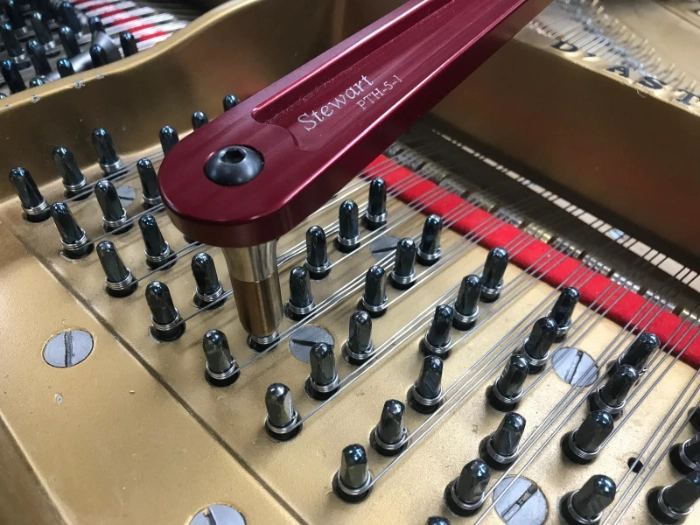
The Stewart PTH-5-1 lever is an invaluable addition to the line of publicly available piano tuning hammer designs in piano technology.
At first, I steered clear from the Stewart because it was all metal and didn’t look “traditional”. When I decided to give it a try, however, I found that its design and functionality reinforces tuning pin stability. It profoundly helps you feel the tuning pin turn.
Unlike any other lever, I feel that the Stewart is an extension of my arm and fits seamlessly into my tuning flow.
Article Written by William Borchard
The first time I was able to try out the Stewart lever (along with other industry standard tuning hammers) was when I came across the “Wall of Levers” at the North Bennet Street School for piano technology.
After trying out a handful of levers, from the Levitan Classic, to the Fujan, to any of the Reyburns, I ultimately decided to purchase the Stewart PTH-5-1 due to its stiffness, solid engineering, and tuning feeling during piano tuning.
It's made of machined aluminum, with a titanium torque shaft, and has a black plastic handle. It's 11.75" inches long weighing in at 8 ounces. This makes the Stewart feel pretty light in your hand. For those who are used to a dense/heavy hammer, the Stewart may feel too light.
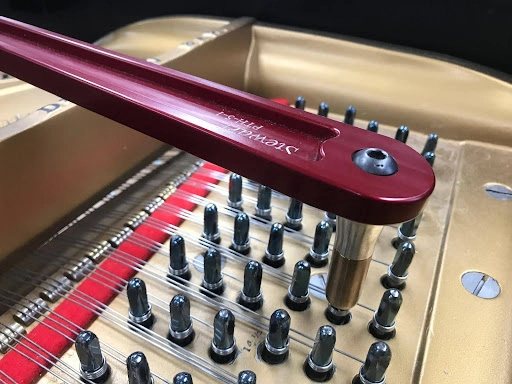
When I first started using the Stewart piano tuning hammer I didn’t take the effort to ensure the tip was fully seated on any of the tuning pins, so I immediately dismissed the lever.
Unlike many typical tuning tips, the Stewart tip has a specifically high tolerance machining - This means that it fits very tightly on most common tuning pins.
This also means that instead of sloppily dropping the hammer on the pin and letting the grooves fit in place, the Stewart requires a bit more intention to place it correctly on the head of each tuning pin tip. This tip style and precision technique experience is similar to that of the new Reyburn ProTip; a similarly well designed and machined tuning hammer pin tip.
The angle of the tuning head tip is 5 degrees against the rest of the lever, which allows for a more direct transfer of power between the lever arm and the pin. I find that when I placed the tuning hammer at 12 o’clock (parallel to the speaking length of the string) there's hardly/scarcely any unintentional flag-poling.
Similarly, intentional flexing of the pin is easy and precise with its low-angle geometry.
The Stewart lever is made by KineOptics, a design and machinist company based in Washington State who produce and design scientific engineering instruments or tools.
The result of this engineering ingenuity clearly demonstrates in the thoughtful design of the Stewart handle, especially how they designed the torque stress, which is evident in the FEA (Finite Elemint Analysis) research on their website.
Ultimately, giving the tuner an even feel wherever you hold the handle, leading to increased rigidity.
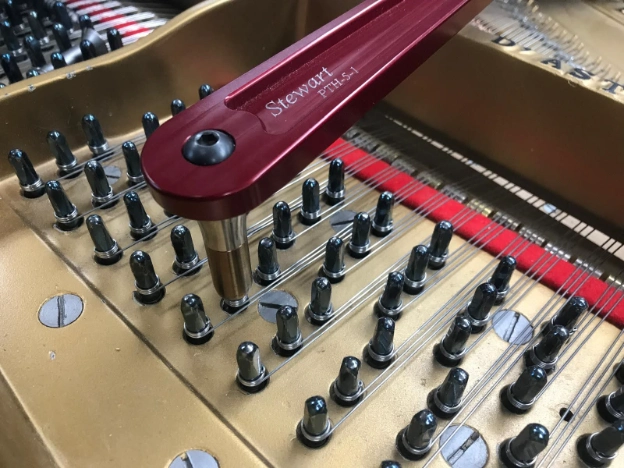
The best feature this lever possesses is its extreme rigidity.
The design process has cut out any extra play or looseness between the tuner and the movement of the pin. You can feel every single degree of movement at the foot of each tuning pin with the Stewart; providing greater definition than any other lever I’ve ever tried.
These engineering improvements create greater stability and a more intuitive experience when “setting the pin”.
For me, as a technician, stability is everything. So, it's a no-brainer that such a lever helping me achieve greater stability is well worth the investment.
As I hear of a growing number of high-level concert technicians adopting the Stewart, I’m guessing that this must be part of their logic as well. When your tunings are getting pounded by the most formidable pianists, you then realize how significantly you must level-up your stability game.
The features that I wish were different about the Stewart is as follows:
For one, the handle...
While not uncomfortable, I think a more ergonomic plastic end could be designed. A technician with access to a 3D printer could likely make their own. I often find myself wanting to rest the plastic end of the lever on the “balls” of my ring and index finger, extending my hand and thumb towards the tip end.
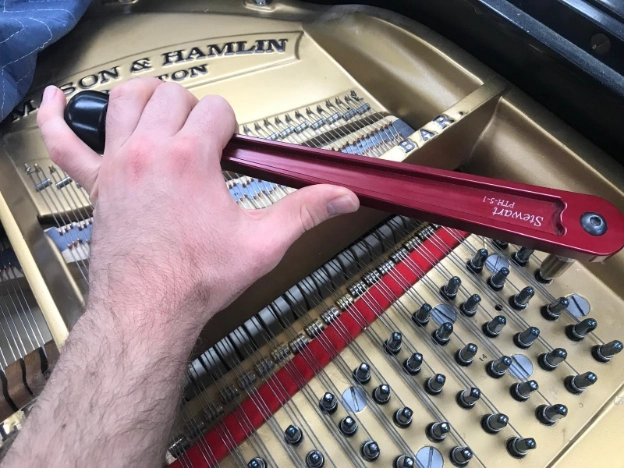
This hand position on the lever can cause long term pain if used over many years.
I've heard that this will likely cause arm or joint pain in the future, so I need to drop this habit. All in all, it's less comfortable to grip the plastic end of the Stewart lever with your palm than as you would a typical Fujan or a Reyburn.
It's similar in style to how I see tuners hold a Levitan Classic or older extension lever. An enterprising technician could probably experiment with different designs and try to replace the original plastic end for an improvement in comfortability.
...and number two, the oversized tuning pin head...
The only other downsides of the Stewart is its oversized head because it won't always have clearance between the stretcher and the closest tuning pins in the low tenor section. It also frequently won't fit the A0 and A#0 tuning pin. This likely means you'll have to carry another lever in order to prevent damaging case parts during regularly scheduled tunings.
I carry a Levitan utility piano tuning hammer just in case. It adds little extra weight, however, this compromise is worth the benefits of being able to use the Stewart lever in most circumstances.
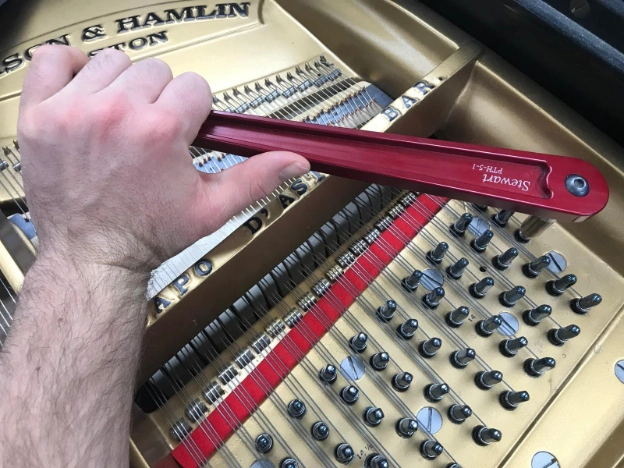
A better and more natural hand position for the Stewart, however, you must be sure not to ‘push’ with your thumb. Thumb support would be only used for the pulling motion.
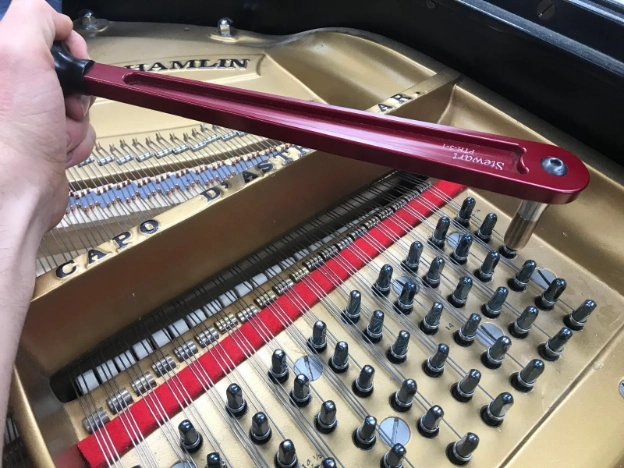
The most ergonomic, although less intuitive, hand position for the Stewart. For some, the size of the end may be too small to comfortably use this position.
The price of the Stewart PTH-5-1 as of November 2025 is $405 + shipping (tuning tip included). This puts the Stewart on the higher end of levers coming in a little pricier than a Fujan, but cheaper than a typical Reyburn.
The lever pays for itself in two or three tuning appointments.
For me, the Stewart is worth the price, but I think this is true of any lever that helps a technician achieve tuning stability.
If you're struggling with tuning stability I would highly recommend you purchase a Stewart. Especially for new technicians starting out who could use a stability “boost”.
However, for those who are content and getting good results with their levers, why change what’s working?
"If it ain’t broke, don’t fix it!"
Article Written by William Borchard
Read Next:

Best Piano Tuning Kit for a Beginner: Review 2024

Xuyiyue Piano Tuning Lever and Tool Kit Review
